
Many executives reach the end of their corporate career and feel ready for a new chapter.
Not another internal role.
Not another political environment.
Not another title.
But their own business.
Based on experience.
Based on judgment.
Based on 25+ years of seeing what really happens in companies.
That is a strong foundation.
But it is not enough.
Because the first question is not:
“What can I offer?”
The better question is:
“Who should I serve first?”
Why this matters
When you start as an independent expert, every conversation feels valuable.
A former contact reaches out.
A company has a problem.
Someone asks for your opinion.
A possible project appears.
At the beginning, this feels good.
But it can also become dangerous.
Because if you follow every opportunity, you do not build a business.
You build dependency on chance.
And chance is not a strategy.
What I learned
When I started my own business, I had to become very practical.
I looked at my market.
I looked at companies I knew.
I looked at industry magazines, trade fair catalogues, industry summits, websites, and sure, also to old contacts.
Then I reduced.
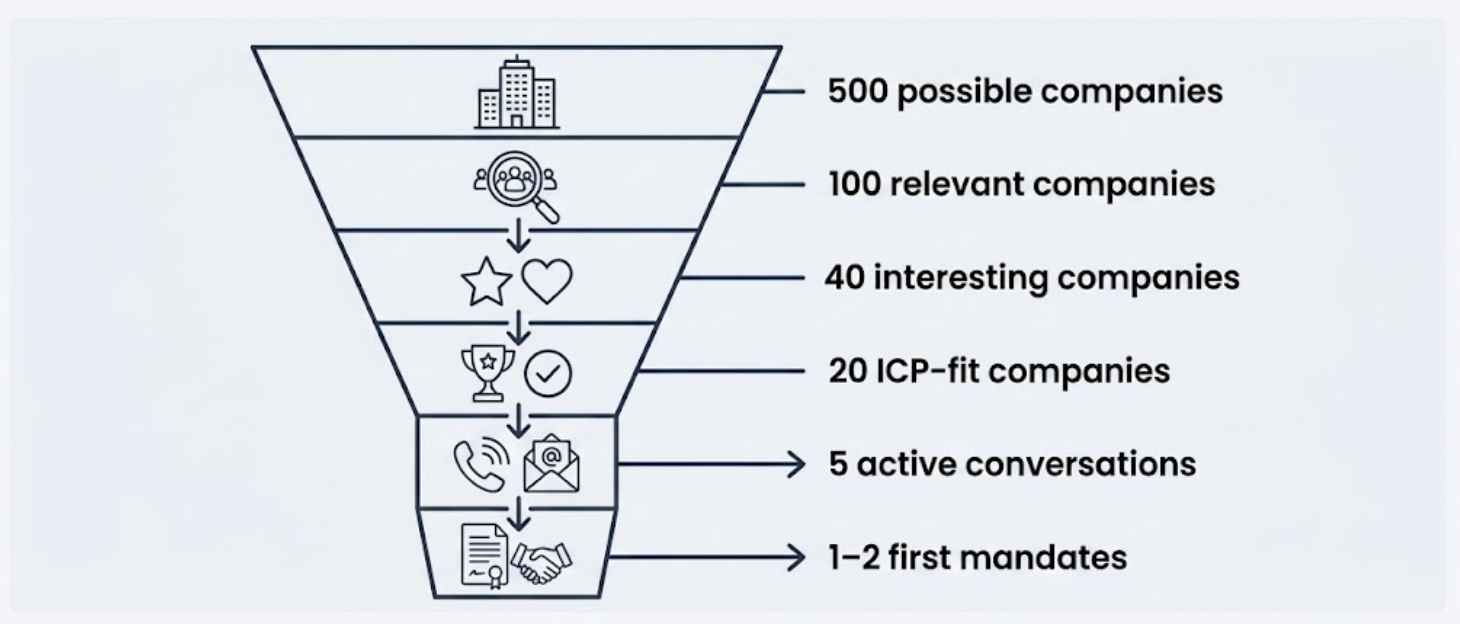
From many possible companies to around 100.
From 100 to maybe the 20 most attractive.
Not because the others were irrelevant.
But because I had to focus.
As a solopreneur, you cannot work the whole market.
You need a small number of companies where four things come together:
They have a problem you understand.
They feel enough urgency to act.
They have the budget to pay.
They have a growth story I see.
They can become more than a one-time project.
That becomes your real ICP.
Not a marketing exercise.
A straight forward business decision.
A-, B- and C-customers
Over time, I nailed it down to three groups.
A-customers are the clients you ultimately want.
Strong companies.
Serious problems.
Real budgets.
Mutual understanding.
Long-term potential.
But they are often difficult to win at the beginning. They already have consultants, processes, and trusted advisors.
It might take 1-3 years to get the foot into the door. But there are always opportunities. And this requires persistence and showing up also when you here another "No".
B-customers are often the best starting point.
They are professional enough to understand your value and willing to pay for it. At the same time, they are accessible enough for you to reach the real decision-maker.
The path is shorter. The decisions are faster. The problem is usually clearer. And especially in the early phase of building your new business, that matters.
You do not need the biggest possible client first. You need to get practise and experience when it comes to delivering of your services. You need the first serious client who sees the problem, trusts your experience, and is ready to move.
That is why B-customers are often where the first real win becomes most realistic.
C-customers can be dangerous.
They may have fascinating problems. They may like your expertise. They may even need you badly.
But if they cannot pay, they cannot become the foundation of your business.
You can stay in touch with them.
But you should not build your second career around them.
The real shift
In corporate life, complexity often comes to you.
As an entrepreneur, you must choose where to apply your experience.
That means you stop asking:
“Who could need me?”
And start asking in a sharper way:
“Where does my expertise meet urgency, budget, trust, and repeatability?”
That is where your business begins.
You do not need 500 prospects.
You need the right 20.
You do not need to convince everyone.
You need to become highly relevant to the few who truly fit.
The lesson
Your first customers are not only revenue.
They are feedback.
They show you whether your positioning works.
Whether the problem is painful enough.
Whether your offer is clear.
Whether your business can become repeatable.
This is why your ICP matters.
It protects your time.
It protects your energy.
And it protects your second career from becoming a collection of interesting conversations.
Expert Shift OS Program
Mid of June, I am starting the next Expert Shift OS Program.
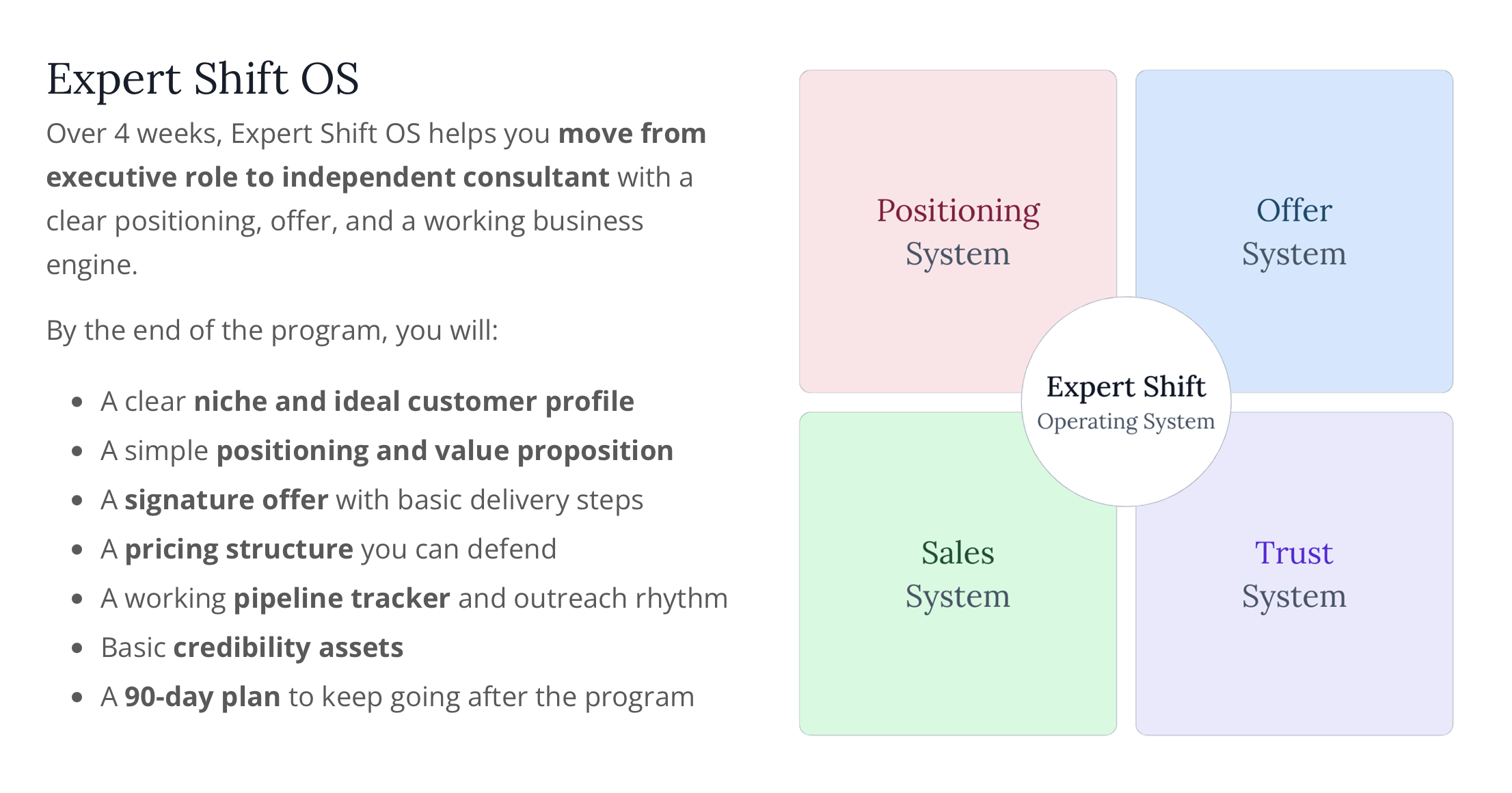
It is designed for senior executives who want to build their own business in consulting, interim management, or executive search.
One of the first things we work on is exactly this:
- Defining your ideal customer.
- Clarifying your offer.
- Building your trust system.
- Creating a practical sales approach.
And turning your experience into a business that can grow.
Because the move from Executive to Entrepreneur becomes much easier when you stop chasing opportunities — and start building a system.

Responses