
Our parents and grandparents rarely had that opportunity.
By their late fifties or early sixties, many had spent decades doing physically demanding work. Medical care was different. Life expectancy was shorter. Retirement often marked the end of their productive contribution.
Our generation is different.
Most senior executives are knowledge workers.
You’ve spent decades making decisions, leading transformations, building businesses, navigating crises and developing judgment that cannot be learned from a book or an AI prompt.
And thanks to better healthcare, better lifestyles and longer life expectancy, many of us have something previous generations never had:
Another 20 or even 30 productive years.
That changes the question completely.
The question is no longer:
“When will I retire?”
It’s becoming:
“What do I want to do with these extra years?”
Do you want to stay curious?
Keep learning?
Remain mentally sharp?
Be surrounded by people who challenge your thinking?
Continue creating value?
Be appreciated for your experience rather than defined by your age?
Because here’s the reality.
Companies don’t always know what to do with experienced leaders.
I see this almost every day.
As an executive search consultant, I’ve had the privilege of placing senior executives well into their sixties. Normal in North America, however untypical in Europe as I also know how difficult it can be to convince companies that the best person for a transformation isn’t necessarily the youngest candidate—but the one whose experience perfectly matches the challenge ahead.
Sometimes they understand.
Sometimes they don’t.
Either way, one truth remains:
Your future should not depend entirely on someone else’s hiring decision!
Years ago, while living and working across Latin America, I noticed something that stayed with me.
Many experienced executives in the Americas didn’t see the end of a corporate career as the end of their contribution.
They became advisors.
Interim leaders.
Consultants.
Board members.
Often combining several of these roles.
Not because it was fashionable.
Because continuing to contribute was simply part of life.
Today, that opportunity is greater than ever.
Knowledge is everywhere.
AI has made building a business faster than ever before.
But one thing has become even more valuable:
Experience.
Judgment.
Perspective.
And learning from people who have already walked the path.
That’s why I created The Executive Reinvention Club.
Not because the world needs more consultants.
But because I believe experienced leaders deserve a better way to prepare for the next chapter of their lives.
One that doesn’t begin after leaving corporate.
One that begins while you’re still in it.
Where you can explore what’s possible, learn from best practices, learn from others, build clarity and create options—long before you actually need them.
Because reinventing yourself isn’t about escaping your current career.
It’s about making sure your experience continues to matter for decades to come.
Longevity isn’t just about living longer.
It’s about staying healthy enough to contribute, curious enough to keep growing, and courageous enough to write another chapter.
If you’ve started asking yourself what that next chapter could look like—even if you’re still fully committed to your current role—I would love to welcome you to the Executive Reinvention Club. That will start in August.
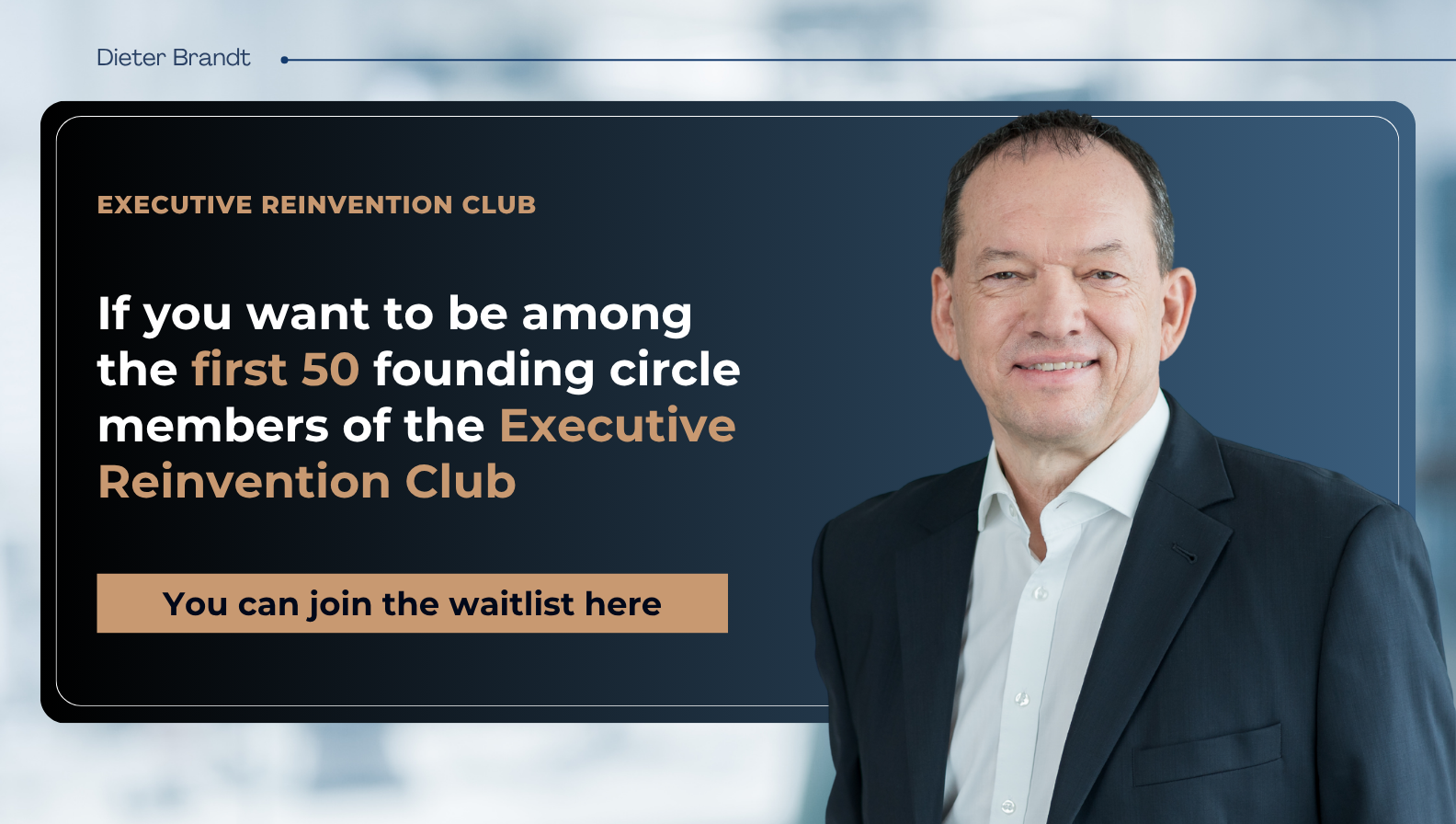
You can join the waitlist here
It’s a place for experienced leaders who believe that the most meaningful work of their lives may still lie ahead.
Because your career doesn’t have to end when your corporate role does.
Sometimes that’s exactly where your most rewarding chapter begins.

Responses