
Years ago, when I first stepped into sales leadership, I still thought the goal was simple: fill the funnel.
Every lead was a good lead. Every customer a win.
But then came the lessons.
One type of clients was simply too small — they kept us busy, but little profitable.
Another used us as leverage to pressure their usual supplier — stringing us along, only to drive down someone else’s price.
And then there was Manaus.
A significant new customer, a deal with a very special equipment too big to ignore.
The catch? Their production site was deep in the Brazilian jungle, in the free trade zone of Manaus. Our normal set up wouldn’t make it to attend such a demanding client in case of emergencies.
If we treated them like a “normal” client, sending teams and support on-site every time, we would have burned through time and money faster than the Amazon humidity burns through your energy.
The only option: innovate.
We used one of our first remote service and preventive service offerings in the early 2000s — a digital-first support model that let us deliver high-quality service without draining resources. And preventive services for capital good was still something really new - especially in the printing industry.
We won the customer.
It worked. We proved we could execute in our capital good business in Brazil - regionally and even globally.
But more importantly: I’ve learned that the right customer profile pushes you forward, while the wrong one drags you down.
Manaus for me became a synonym of innovation and growth, a pass that triggered more and more my life.
Why Your ICP Matters
Without a clear ICP, your own outreach will scatter energy everywhere. And this more than important when building and scaling a sustainable business especially as solopreneur.
Why?
The result where…
- Deals never close
- Clients drain instead of sustain
- Margins shrink instead of grow
A strong ICP does the opposite. It:
- Focuses effort on accounts that fit
- Attracts partners who value the exchange
- Builds long-term relationships where giving and receiving are balanced
With today’s available Know-how, technology and access to networks, serving your ICP became easier than ever before.
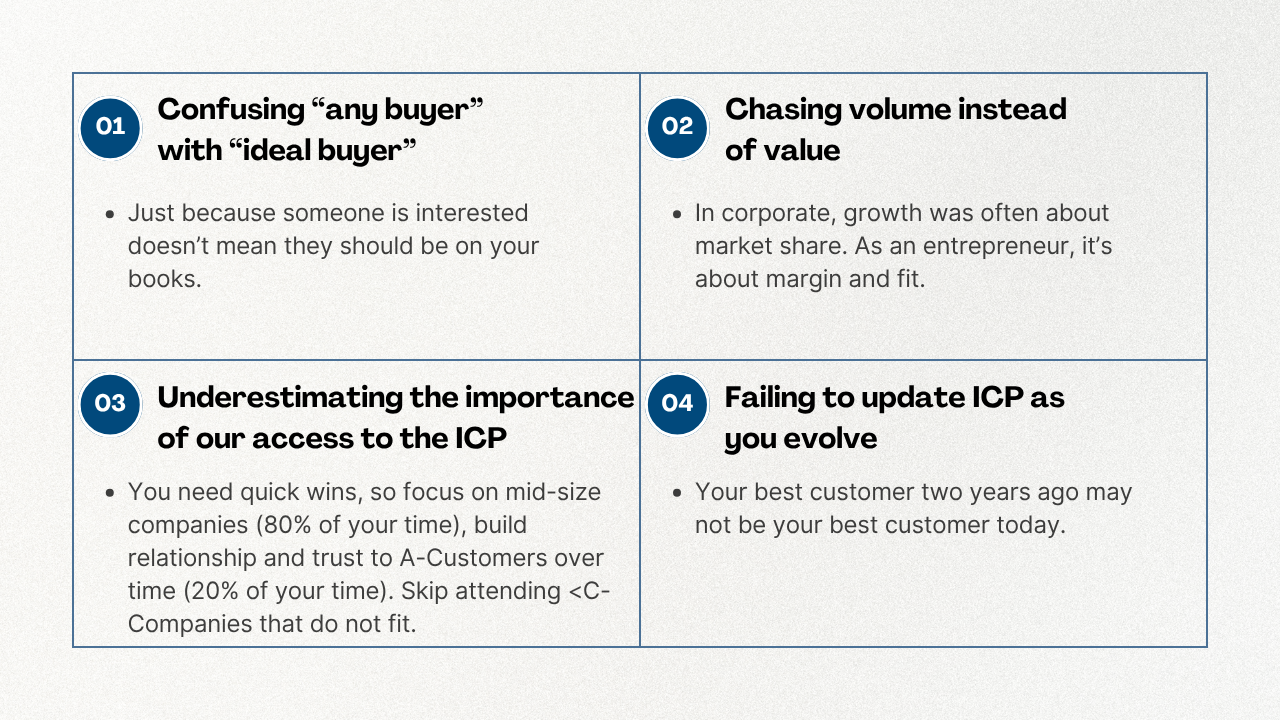
Common Mistakes We Make with ICP
Consider these risks you need to be well aware of:
A Better Way: Sharpen Your ICP
An ICP isn’t a marketing persona.
It’s a decision tool.
- Ability to Invest: Do they have the budget to sustain your value?
- Willingness to Partner: Do they see you as a vendor — or as a partner worth trusting?
- Balance of Give & Take: Does the relationship create momentum, or just extraction?
When you know your ICP, you stop chasing.
You start selecting.
Steps to Put It Into Practice
Part 1: Audit Your Current Clients
Which ones energize you, pay fairly, and grow with you?
Which ones drain you, negotiate endlessly, or distract you from real progress?
Part 2: Define Your Non-Negotiables
- Revenue size?
- Buying power?
- Strategic alignment?
- Cultural fit?
Part 3: Build a “Red Flag” List
Document the signals that say “this is not my client.”
Then stick to it — no exceptions. None.
Evidence or Experiment
I once worked with a other consultants that spent 40% of their time on “Tier C” accounts.
These customers bought small, demanded heavily, and churned fast.
When we redefined their ICP, sales effort shifted to larger accounts with strategic needs and budgets.
Within 12 months:
- Average deal size doubled
- Sales cycle shortened
- Profit margins rose by 15%
Not because they sold more.
Because they sold to the right clients.
What This Means For You
- More is not better: the wrong customers will cost you more than no customers.
- ICP is discipline: it tells you who to serve — and who to walk away from.
- As a solopreneur: your time is the most limited asset and too valuable to waste on non-ideal clients.
Action Step for This Week
List your last five (future) clients and the type of projects you want to run with them - ideally not just one.
Now ask:
- Which one fits my Ideal Customer Profile?
- Which one doesn’t?
- Why?
Then commit:
Next week, all your energy goes only to ICP-fit opportunities.
Final Thought
The (future) clients you will choose define the business you build.
Choose small, draining, or mismatched ones — and your business will mirror them.
Choose your Ideal Customers — and you’ll build a business that compounds.
PS
Who’s your non-ideal client — the one you know is costing more than they give?
Hit reply and tell me.
And if this resonated, forward it to someone still chasing every lead instead of focusing on the ones that actually matter.
Your ICP isn’t just a marketing tool. It’s your strategy to success.

Responses