The AI prompt.
The hidden workflow.
The customers list ready to buy.
The shortcut that turns experience into clients.
Let me reflect first on how I use AI today.
It's about evaluating faster, structure insights, prep client work, and create assets that would’ve been out of reach 2–3 years ago.
Especially as a solopreneur.
I am thrilled to use and grow with and thanks to AI.
AI will become essential for consultants.
Those who ignore this trend won't be relevant tomorrow.
Nevertheless, what I have learned is this:
AI is not the success factor. AI is the amplifier.
It can make good thinking faster.
Clear positioning stronger.
Structured execution more powerful.
But it cannot replace the work behind the work.
It cannot decide which problem I want to own.
It cannot create trust for me.
It cannot have the human client conversation.
Coming back to you as a potential new consultant.
When I speak with senior executives that are thinking about the leap into consulting or interim management this is what I perceive.
Many are not really searching for a tool.
They are searching for certainty.
The perfect timing.
The perfect niche.
The perfect AI workflow.
The perfect guarantee that makes risk disappear.
And then exactly this question comes:
“When can I expect my first turnover?”
I understand.
But from my own experience, the answer is not a date.
Why?
My first turnover was not created by time or tools.
It was created by mindset, execution, network, and the basics.
These became the foundation I built my business on.
1. Mindset
When I became independent, nobody gave me permission anymore.
No title protected my authority.
No corporate structure created my relevance.
No internal process brought the next opportunity.
I had to create motion myself.
Be visible.
Start lot of conversations.
Hearing “not now”.
Coming back again and again.
Sharpen my message.
Learn from my errors.
Commited to my "why".
Repeated simple actions until the market responded.
That was not always comfortable.
But it was crucial and necessary.
Because my business did not grow from what I knew.
It grew from what I put into motion.
2. Execution
Years ago, I attended a seminar with a former board member who had worked closely with Jack Welch at GE.
One sentence stayed with me:
Many corporations do not fail because they have no strategy.They fail because they do not execute.
I had seen this in corporate life.
Too many initiatives.
Too many meetings.
Too little follow-through.
Later, I saw the same in entrepreneurship.
People attend summits, workshops, webinars, or meetings.
But attending is just not execution.
For me, execution meant doing the work even when it felt hard or repetitive.
Following up. Testing offers. Improving positioning. Creating trust-building assets. Starting client conversations.
Not glamorous.
But effective for building a prime business.
3. Network
I also learned that building alone is expensive considering time, stress, missing opportunities and money.
Many executives try to create everything from scratch:
Positioning. Tools. Sales system. Content. Client journey.
That may sound independent and economic.
But often it is a tough isolation disguised as independence.
I learned to use wheels that already moved.
Simple. Fast. Most effective.
And I trained myself focusing on this:
To listen.
To ask.
To re-engineer.
To use and improve what worked.
To adapt instead of inventing everything from zero.
I lived and worked abroad for 20 years before starting my consulting business. I started my business with "0" LinkedIn connections...
A strong network that was built from then onwards that saved me time, stress, and money. And I gained access to people that lived the same dream.
More importantly, it helped me keep moving when doubt showed up. And there were many, however I accelerated fast.
4. The Basics
Now comes the fun part most people want to skip especially in times like this.
What they try to do is this:
AI before positioning.
Content before clarity.
Leads before a clear offer.
Revenue before a trust-building process.
What I did instead was this:
I made progress when I focused on the basics.
A clear positioning:
a specific problem, for a specific client, with a specific outcome.
An offer system:
a simple way for clients to start working with me.
A sales system:
a structured way to create conversations and move trust toward a decision.
Trust-building assets:
frameworks, case stories, powerful open questions, improving online presence, and conversation structures.
It simply made the client think:
“This person understands my world.”
“This person can reduce my risk.”
“This person can create a predictable outcome.”
That is the champions league type of game I like to play (and assist).
The question changed
Today, AI will make the market even louder.
More people will publish.
More people will offer consulting.
More people will sound professional.
But clients do not buy noise.
They buy confidence.
Relevance.
Trust.
Reduced uncertainty.
A clear path from problem to result.
That is why it should stop asking:
“When will the first turnover come?”
The correct question should be:
“What am I willing to execute consistently until the market responds?”
Because turnover is not the starting point.
It is the result. Of mindset. Execution. Network. And the basics.
AI can help you move faster.
But only if you are already moving embracing these pre-conditions.
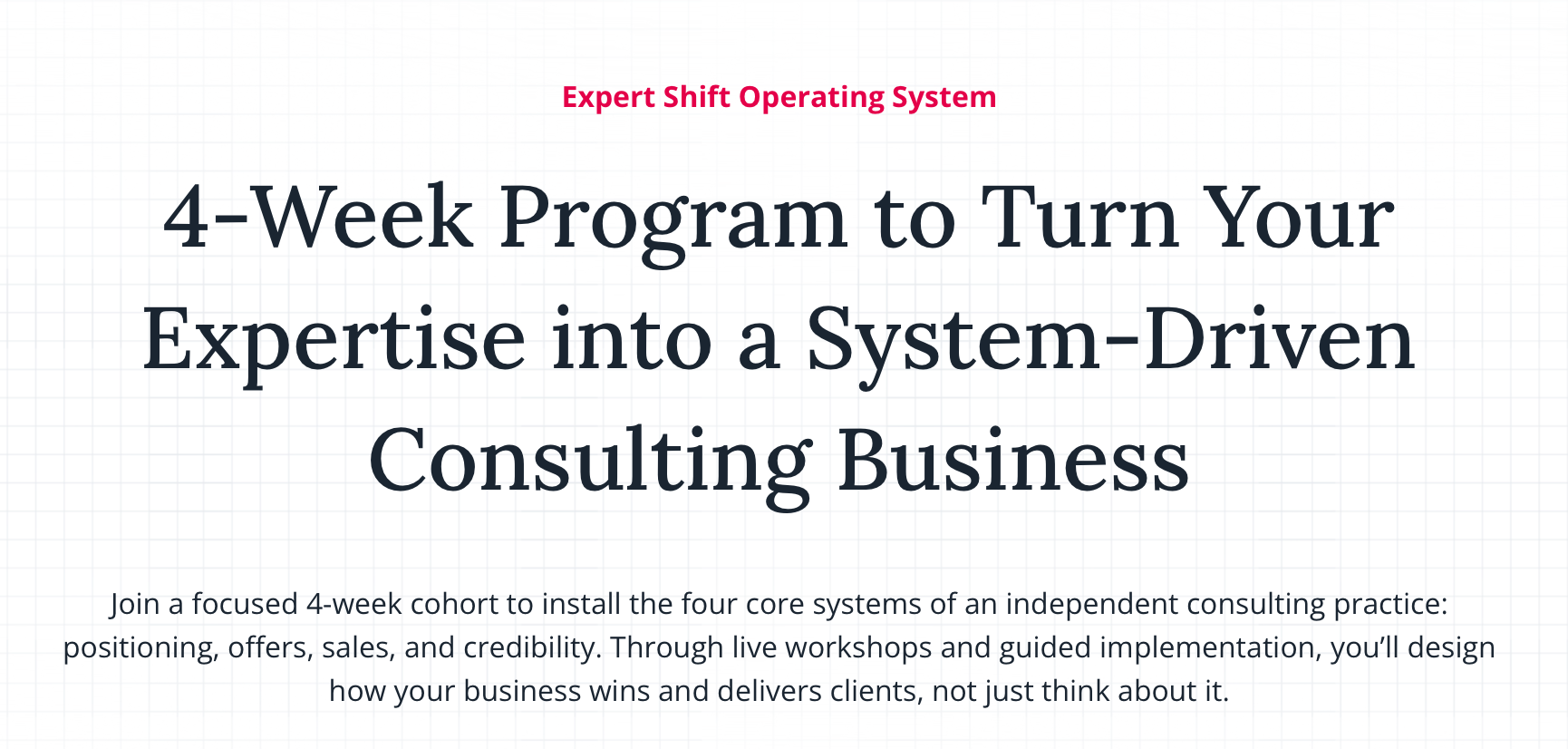
This is why I created Expert Shift OS
A practical operating system for senior executives who want to turn their experience into a focused consulting or interim management business.
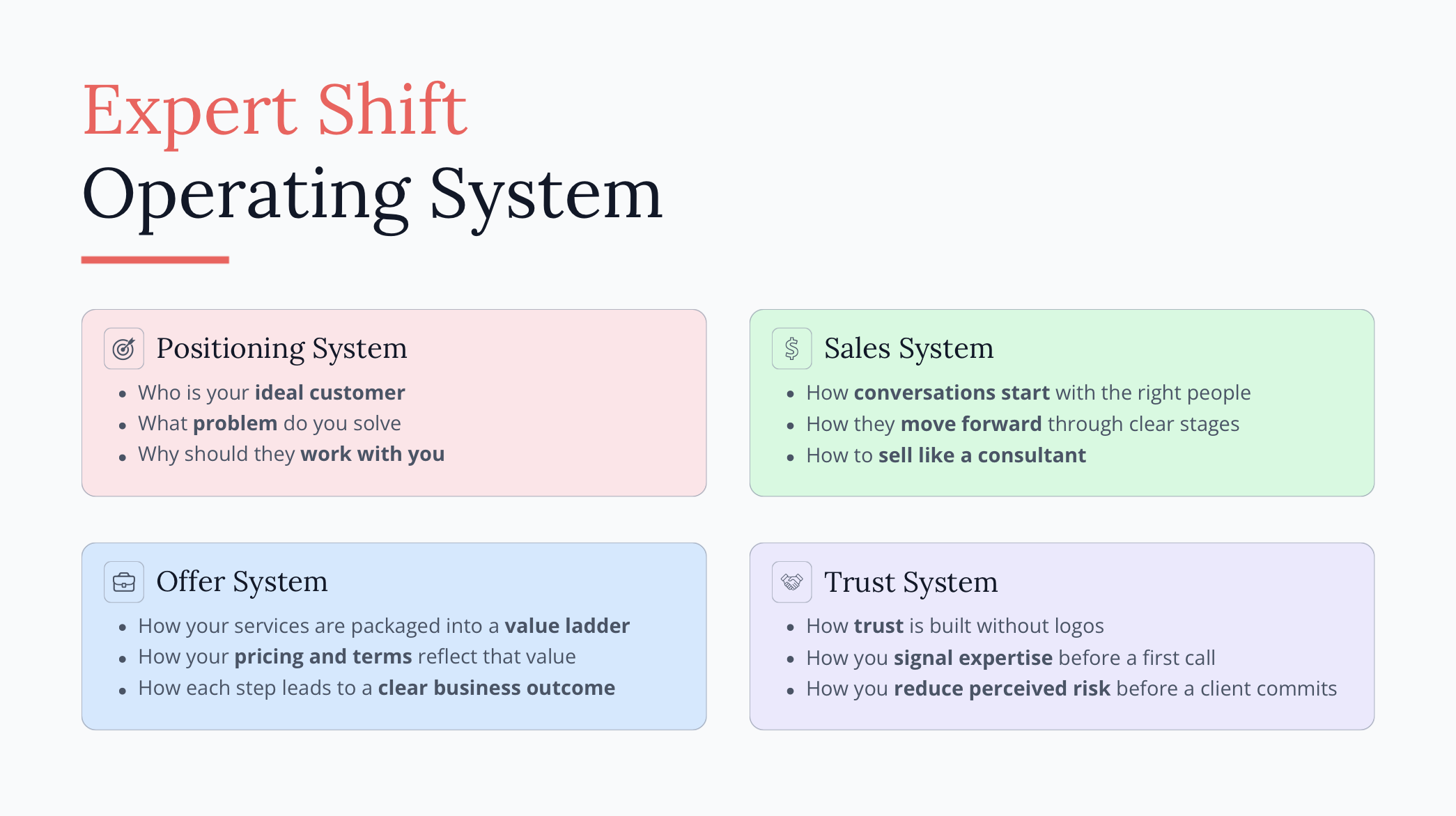
Inside Expert Shift OS, we work on these topics:
Mindset.
Execution.
Network.
The basics.
And we translate them into what truly matters:
Positioning. Offer system. Sales System. Trust-building assets.
Your experience has value.
But the market will only see it when you translate it into a clear problem, a strong offer, and a repeatable way to create trust.
Expert Shift OS helps you build exactly that.
Join Expert Shift OS Program in May or June and build the system behind your next professional chapter.

Responses