
Turn a family decision into your unfair advantage when leaving corporate.
Make the Leap Together
Late Tuesday. Kitchen light on. Half a glass of Merlot on the counter. I looked like I’d just come off a board meeting — that worn, polite focus executives wear when they’re trying to sound confident and not spook anyone.
“I’m 53,” I said. “If I don’t do it now, I won’t do it.”
Across from me, my wife held the stem of her glass like a lifeline. “Do what exactly?” she asked. Not hostile. Not thrilled. Mostly tired.
I launched into my notes on my iPad — how I could use my industry experience, my network, and my track record to start building something of my own. She listened in the way people listen when they’re deciding if they’re safe. When I finished, she asked one question: “How long until we’re okay if it doesn’t work?”
I didn’t have a clean answer. That was the real issue. Not the story. Not the idea. Not my expertise. It was that simple, human question living underneath the plan.
The Big Problem
Leaving corporate at 50+ is never just a career decision. It’s a family decision wearing a career suit. Your spouse is not a stakeholder to “manage.” They’re your first business partner. Your most important one.
When leaders forget this, fear walks in. The fear is rarely about failing in business. It’s about the blind spots, lifestyle, finances, and risk, being left vague. Vague is where anxiety breeds. And anxiety kills good ventures. Quietly, over dinner.
Why the Usual Approach Fails
Most executives try to “sell” the leap at home the way they’ve sold big bets at work: a confident narrative, a few charts, a heroic timeline, and the promise of optionality. It’s a pitch. The intent is good. The effect is vague.
At work, you present to get a green light. At home, you’re not seeking permission. You’re building a shared reality. Different game. Different stakes. You can’t outsource that to a slide deck.
A Better Way
Treat your spouse as your first cofounder. Not your audience. Not your sponsor. Cofounder. That means co-authored vision, explicit guardrails, and shared ownership of the upside and the downside. It turns fear into choice.

Then, build structure around the leap. Not a five-year fantasy. A practical operating model for the next 12 months — lifestyle, finances, pipeline milestones, exit ramps. Structure doesn’t kill entrepreneurship. It makes room for it.
And don’t do it in a vacuum. Talk to people who’ve made the jump, former executives who now run thriving consulting or executive search practices. Borrow their constraints. Borrow their scripts. Guidance from those who’ve done it isn’t nice-to-have. It’s the shortcut to confidence.
Steps to Put Into Practice
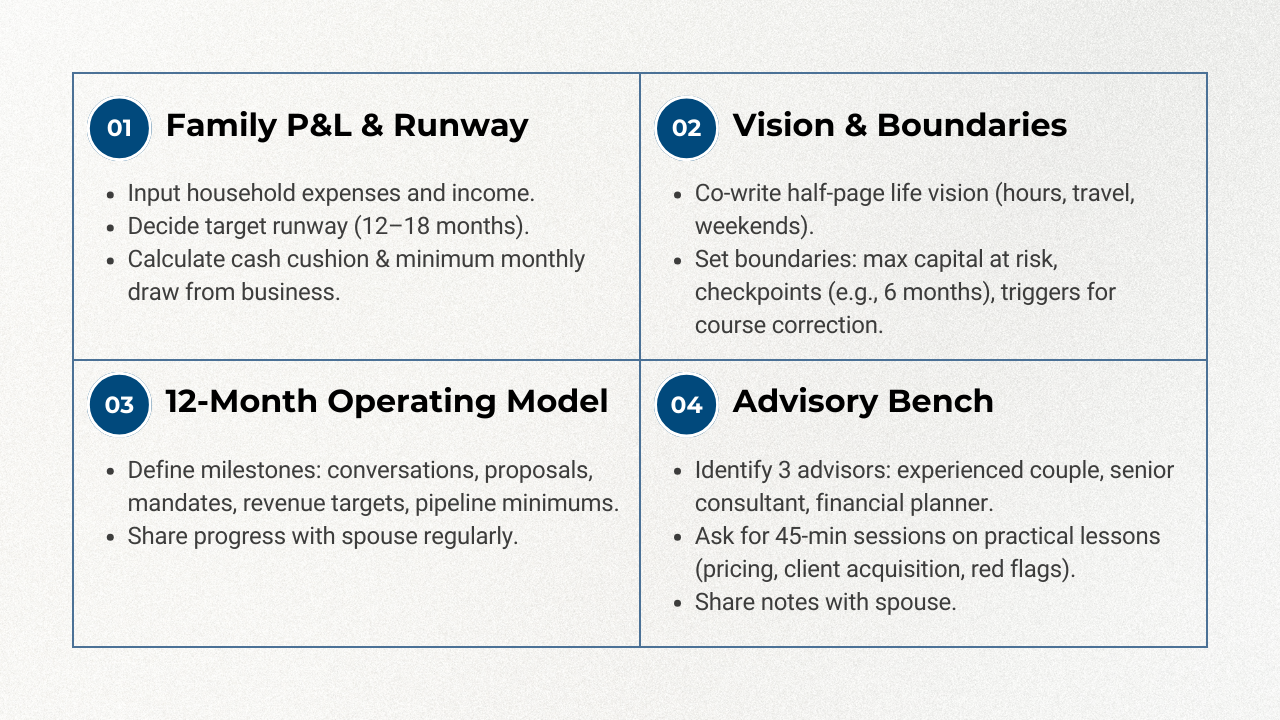
Evidence or Experiment
In corporate, evidence comes from forecasts and models. In entrepreneurship, it comes from conversations and commitments. Don’t announce. Show motion: first client calls, first proposals, first retained project. Each one is a proof point you can bring home. And remember: trust buys time when revenue lags.
Here’s the pattern I see: families don’t need perfection. They need clarity and cadence. Clarity on money and time. Cadence on when you’ll review and reset. When those exist, fear becomes input, not a stop sign.
What This Means For You
• Stop pitching your spouse. Start partnering with them.
• Your runway is a number, not a feeling. Put it on paper.
• Boundaries don’t limit you; they let you be brave inside them.
• Momentum is measured in conversations and proposals before it shows up in revenue.
• Borrow structure from those ahead of you. It shortens the scary part.
Action Step for This Week
Schedule a 60-minute “cofounder at home” session with your spouse. Bring a simple money sheet (last three months of spend), a blank calendar, and a 12-month operating sketch.
Decide together on:
1) Runway months required,
2) Maximum capital at risk in year one,
3) Agreed check-in dates, and
4) Two lifestyle boundaries you won’t violate.
Write them down. Sign and date it. Put the next check-in on the calendar.
You don’t need permission. You need partnership.
That’s what I learned when I made the leap from executive to entrepreneur. And that’s the spirit we build at Brandt & Partners every day.
– Dieter Brandt
Don't forget: your excuses are someone else's opportunities.


Responses