How to Turn Your Experience into a
Lean One-Person Expert Business
Reading time: 5 minutes
For much of my career, growth meant building more.
More people.
More management.
More infrastructure.
More meetings.
More complexity.
That’s how most of us learned to think about business.
And it’s why I sometimes see experienced executives make an interesting assumption when they consider becoming independent:
They think they have to build another company.
They start thinking about a website, an office, employees, partners, infrastructure and all the things a “proper business” is supposed to have.
But what if that is the wrong starting point?
What if the opportunity after 25 or 30 years in business is almost the opposite?
A deliberately small business built around something you already have: your expertise.
This Week
The One-Person Expert Business
There has probably never been a better time to build a highly focused business around professional expertise.
Not because starting a business has suddenly become easy.
It hasn’t.
But because an experienced executive already possesses much of the most difficult raw material:
Knowledge. Experience. Industry understanding. Relationships. Credibility. Pattern recognition.
And perhaps most importantly:
The ability to solve problems that other people have not spent 25 years learning how to solve.
That changes the economics of starting a business.
You don’t necessarily need a factory.
You don’t need inventory.
You don’t need 20 employees.
You don’t need millions in investment.
And you don’t need to recreate the organization you just left.
What you need is a way to turn what you know into something a customer understands, needs and is willing to pay for.
The Expert Brief
Six Building Blocks of a One-Person Expert Business
I have been thinking about this increasingly as a simple operating model.
Not a 50-page business plan.
One page.
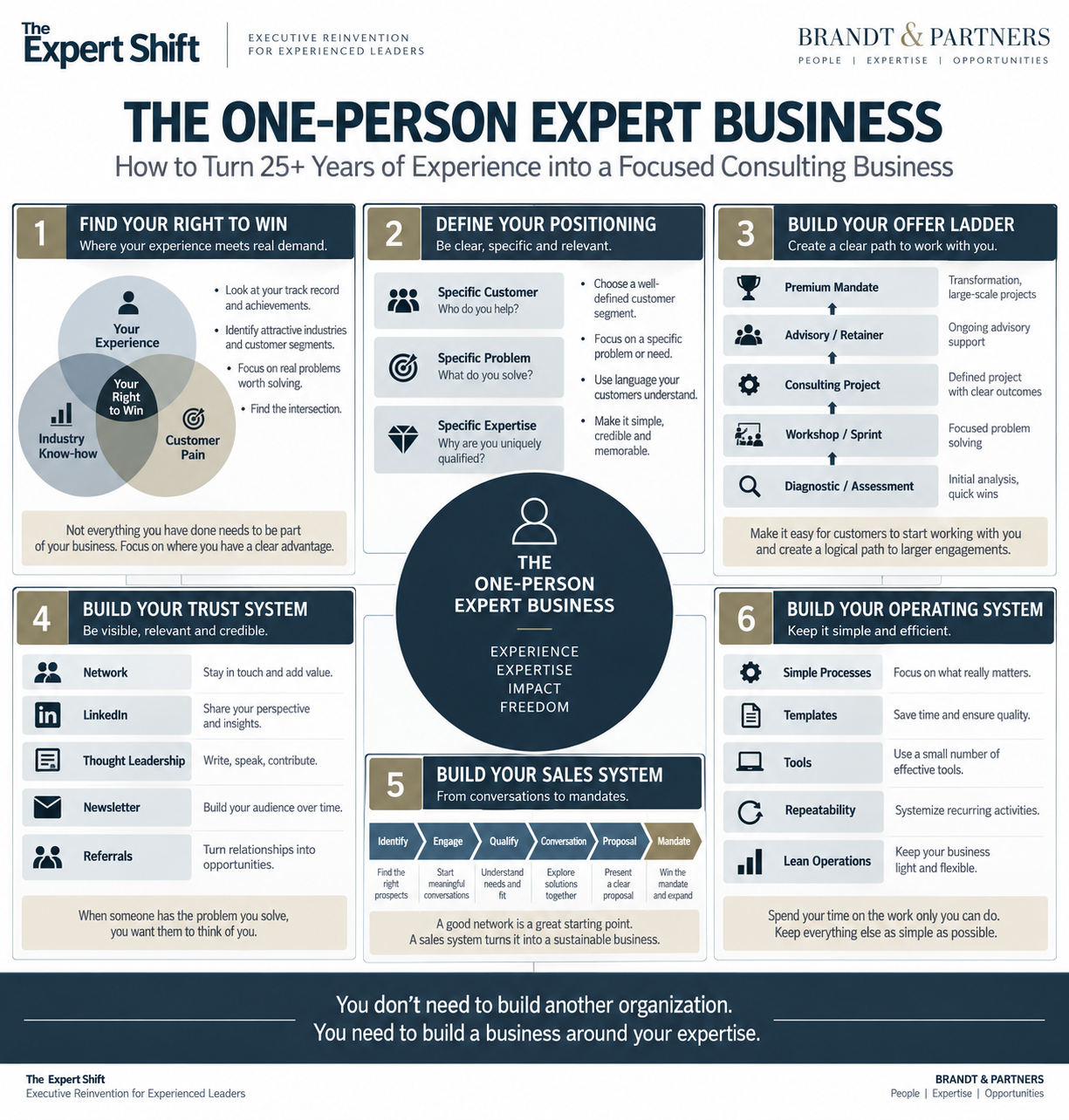
Six building blocks.
1. Find Your Right to Win
This is where everything starts.
Your experience alone is not yet a business.
The opportunity exists where three things intersect: Your experience × Your industry know-how × A customer problem worth solving
Not everything you have done during your career needs to become part of your business.
In fact, trying to sell everything you know often makes it harder for customers to understand why they should hire you.
The first job is therefore not to expand.
It is to focus.
2. Define Your Positioning
Once you’ve found that intersection, you need to make it understandable.
Who exactly do you help?
What problem do you solve?
What makes you particularly qualified to solve it?
This is where many experienced executives struggle.
After 25+ years, leaving something out feels uncomfortable.
But positioning isn’t about denying the breadth of your career.
It’s about deciding which part of that breadth you want the market to recognize you for.
3. Build Your Offer Ladder
Then comes an important transition.
Expertise needs to become something a customer can buy.
“Consulting” isn’t an offer.
Neither is “advisory.”
Your customer needs to understand what working with you could actually look like.
That might start with a diagnostic or assessment.
Which can lead to a workshop or sprint.
Which can become a larger consulting project.
Which may ultimately lead to an ongoing advisory relationship or major transformation mandate.
The objective isn’t to invent as many services as possible.
It is to create a logical path for customers to work with you.
4. Build Your Trust System
In corporate life, much of your credibility came with the organization.
Your title mattered.
The company name mattered.
The organization opened doors.
Once you become independent, the equation changes.
“You become the brand.”
Your network matters.
Your LinkedIn presence matters.
Your ideas matter.
Your point of view matters.
Your content matters.
Your references and proof matter.
The goal isn’t to become an influencer.
It is much simpler: When someone has the problem you solve, you want them to think of you.
5. Build Your Sales System
One of the most dangerous assumptions in starting an independent business is: “I have a good network. Something will come.”
Something probably will.
But hope is not a sales system.
A sustainable expert business needs a repeatable process:
Identify → Engage → Qualify → Conversation → Proposal → Mandate
Your network remains enormously valuable.
But instead of treating it as a collection of contacts, you start treating business development as a process.
That’s the difference between occasionally finding work and building a business.
6. Build Your Operating System
And finaly, kepp the business deliberately simple.
Every new process, tool, service and recurring activity should answer one question: Does this make the business better — or simply bigger?
You don’t need corporate bureaucracy in miniature.
You need simple processes.
Good templates.
A small number of useful tools.
Clear routines. Repeatability.
And an operating model that allows you to spend the majority of your time where you create the greatest value: with clients and on the work only you can do.
Why This Matters
For many experienced executives, independence is attractive because of what it promises:
More autonomy.
More flexibility.
More control over your time.
The ability to choose your clients and projects.
And the possibility of continuing to create value from decades of accumulated experience.
But there’s an important trap.
If you build a business that requires employees, layers of management, increasing fixed costs and your constant presence, you may eventually recreate many of the things you wanted to leave behind.
That’s why I find the idea of the One-Person Expert Business so compelling.
The objective isn’t maximum headcount.
It isn’t maximum complexity.
And it isn’t building an organization for the sake of having an organization.
The objective is:
A focused business built around your expertise, serving a relatively small number of customers extremely well.
Small organization.
High expertise.
High customer value.
And potentially, much greater freedom.
One Next Step
There are two ways you can take the next step with me — depending on where you are today.
1. I'm Exploring
Perhaps the idea appeals to you, but you’re still asking: Could I really turn what I know into a meaningful source of income?
Then join me on September 29 for my free live webinar: From Executive to Entrepreneur. We show you
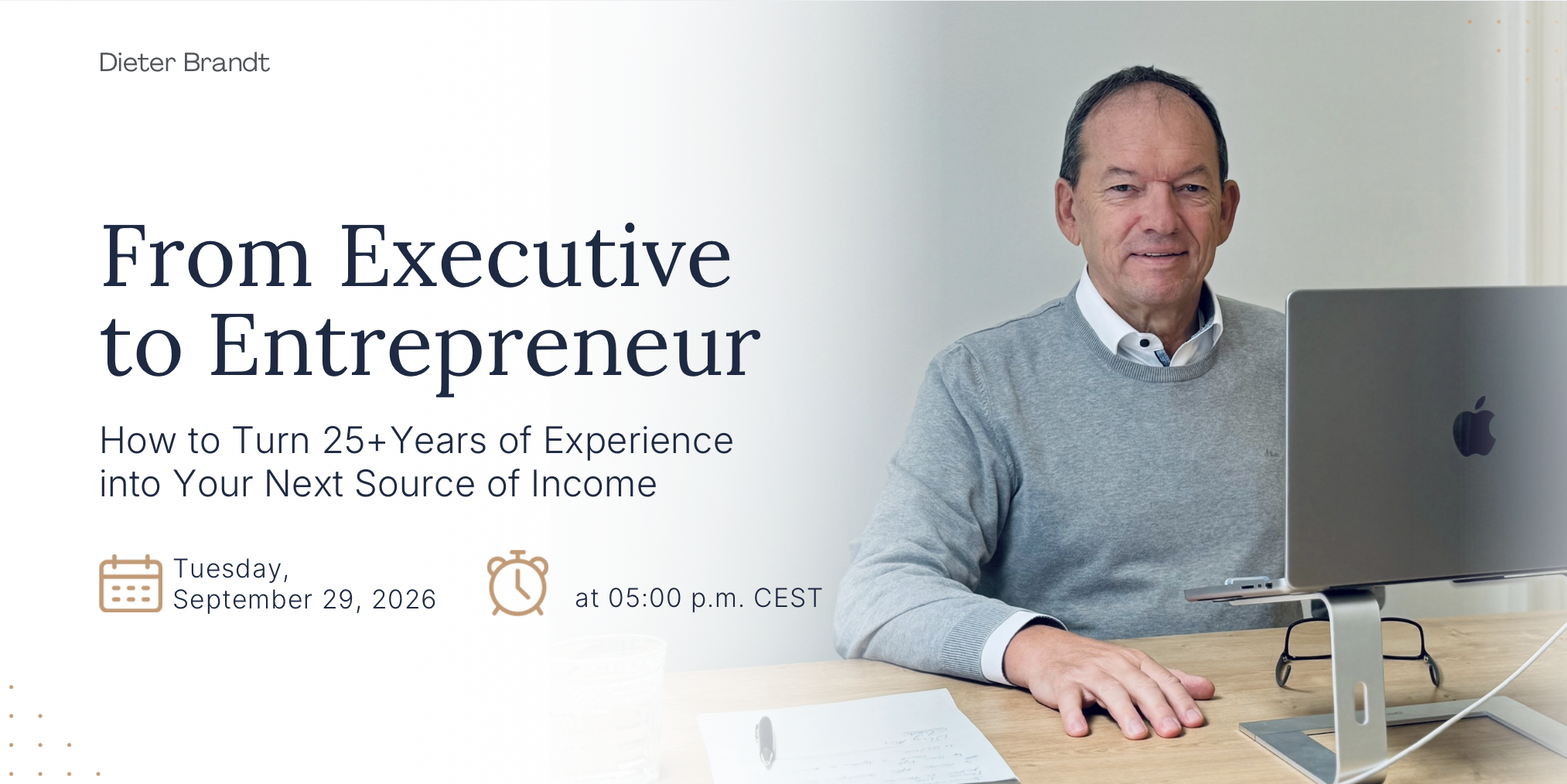
We’ll explore how experienced executives can identify the commercial value hidden in their experience and start turning it into a viable next professional chapter.
RESERVE YOUR PLACE FOR SEPTEMBER 29
2. I'm Ready to Build
Perhaps you’re already beyond that question.
You know that you want to build an independent consulting or expert business.
Then you don’t necessarily need more inspiration.
You need to build it.
That’s what Expert Shift OS is designed to help you do.
Over four weeks, we work together on the four core systems:
POSITIONING -> OFFER -> SALES -> TRUST
You receive:
- 4 live workshops
- 4 individual 1:1 Q&A and implementation sessions
- Access to all recorded workshops
- All presentations and frameworks
- And most importantly, the Expert Shift OS Workbook that guides you step by step from your experience and industry know-how to your own business concept.
You don’t start with a blank sheet of paper.
You work through a structured system designed to answer four fundamental questions:
Who do I serve?
What do I sell?
How do I create opportunities?
How do I become known and trusted for it?
RESERVE YOUR PLACE FOR SEPTEMBER 29
You spent decades building your experience.
The next chapter doesn’t necessarily require you to build another large organization around it.
It may require something much simpler:
Find where your experience creates the greatest value.
Build a business around it.
Keep everything else as lean as possible.
Your best professional chapter may still be ahead of you.
Dieter
The Expert Shift
Executive Reinvention for Experienced Leaders
Experienced leaders derserve another great chapter.
P.S. Not sure whether you’re ready to build yet? That’s exactly why I’m hosting From Executive to Entrepreneur on September 29. Come to the webinar first.
And if you already know where you’re heading, Expert Shift OS is where we can start building it together.

Responses