
When I left corporate life after more than three decades, I certainly didn’t have a lack of experience.
I had spent many years in senior management positions, worked internationally, led businesses and teams, carried P&L responsibility and dealt with many of the situations that come with running a business.
I knew an industry extremely well.
But there was one question my CV couldn’t answer for me right away:
How do I turn all of that into a profitable business of my own?
I believe this is one of the most underestimated challenges when experienced executives consider becoming independent.
You don’t start with nothing.
Quite the opposite.
You start with almost too much.
Twenty or thirty years of industry knowledge, leadership experience, relationships, successes, mistakes, difficult decisions and lessons that somebody entering the profession today would need years to accumulate.
There may be five or ten different things you could do with it.
But which one should become your business?
That is where the real work begins.
I had to go through that process myself before I started my own business at 54. And today, after working with many executives making a similar transition, I know that there is a much more systematic way to approach it.
You have to translate experience into a business
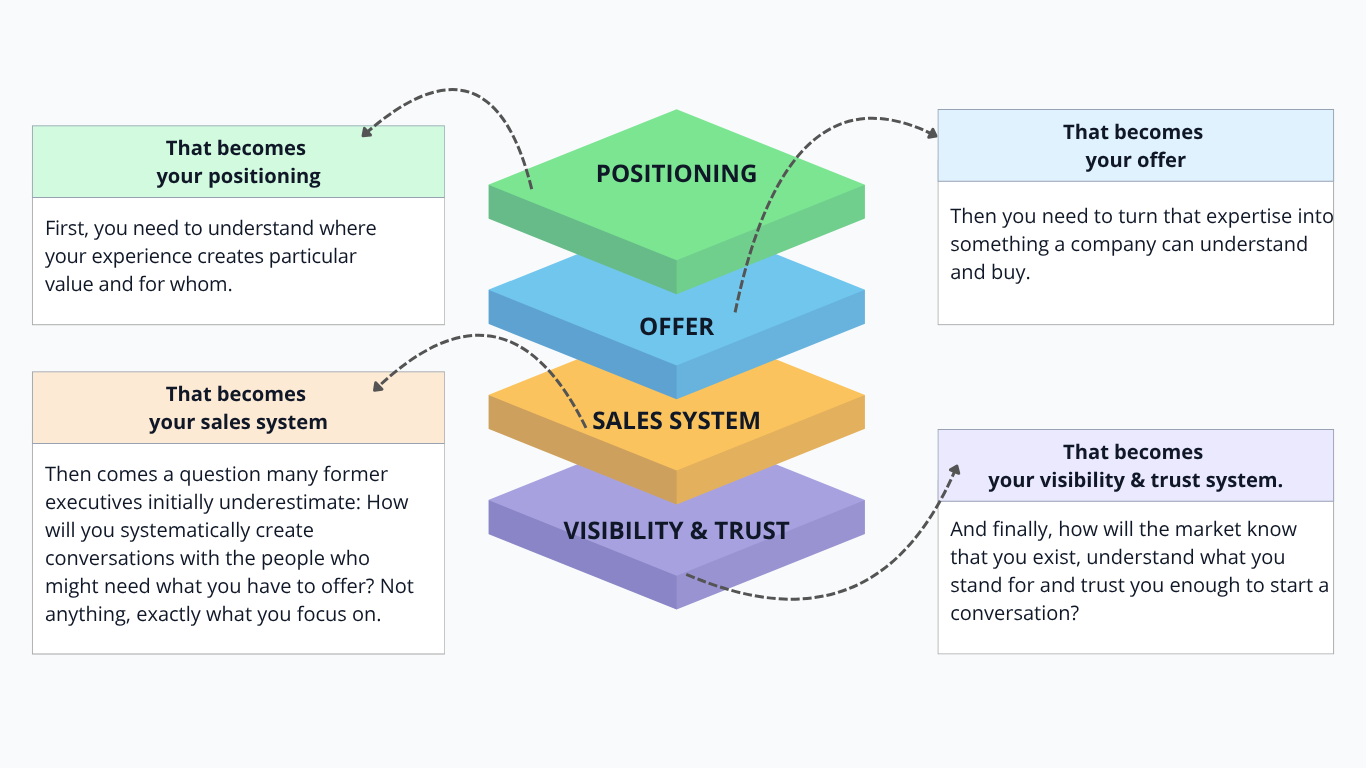
None of these questions is particularly complicated on its own.
Getting all four to work together is what begins to turn experience into a business.
And I wish I had had a structured process for doing exactly that when I started.
This is why we created Expert Shift OS
Expert Shift OS is a four-week working program for experienced executives who want to turn their industry know-how and professional experience into a clear consulting business concept.
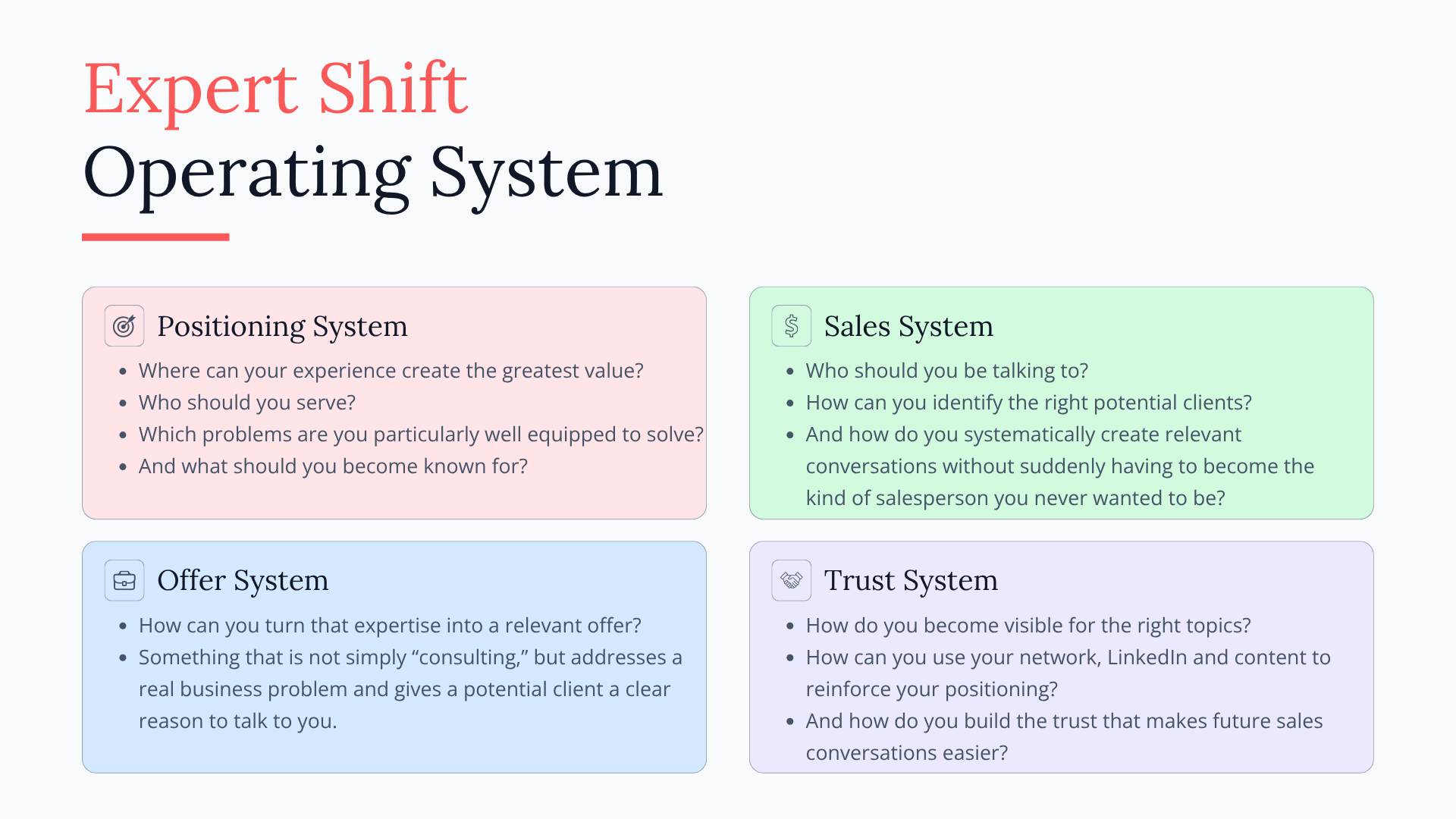
Over four weeks, we work through the four building blocks together:
-> Week 1 — Positioning
- Where can your experience create the greatest value?
- Who should you serve?
- Which problems are you particularly well equipped to solve?
- And what should you become known for?
-> Week 2 — Offer
- How can you turn that expertise into a relevant offer?
- Something that is not simply “consulting,” but addresses a real business problem and gives a potential client a clear reason to talk to you.
-> Week 3 — Sales
- Who should you be talking to?
- How can you identify the right potential clients?
- And how do you systematically create relevant conversations without suddenly having to become the kind of salesperson you never wanted to be?
-> Week 4 — Visibility & Trust
- How do you become visible for the right topics?
- How can you use your network, LinkedIn and content to reinforce your positioning?
- And how do you build the trust that makes future sales conversations easier?
Four weeks. But not four lectures.
Every Monday at 5:00 p.m. CET, we meet for a live working session focused on one of these four building blocks.
And between those sessions, you don’t disappear for a week and try to figure everything out on your own.
You also have an individual Q&A session each week.
Four live Monday sessions.
Four individual Q&A sessions.
All necessary templates to adapt to your business.
The purpose is simple: to work through your individual questions, challenge what you have developed and make sure you are well prepared for the next step and the upcoming session.
Because this isn’t a program I want you to simply consume.
I want you to build something.
At the end of four weeks, I don’t want to tell you that you have built a successful consulting business.
Nobody serious can promise you that.
I want you to know what business you are going to test.
That is a very different thing.
You should be able to explain what you stand for.
Whom you help.
Which problem you solve.
What you offer.
How you intend to create sales conversations.
And how you will build visibility and trust around your expertise.
Then you can stop debating the idea endlessly with yourself.
You can take it outside.
Talk to potential clients.
Listen.
Adjust.
Improve.
And work towards the evidence that ultimately matters: your first one or two real mandates.
Because that is when an idea starts becoming something much more important.
Proof that there is a market for what you know.
There is another reason why this matters to me
When you have spent 20, 25 or 30 years building a successful career, starting something of your own isn’t a casual experiment.
You have built a reputation.
You have responsibilities.
And you don’t want to throw all of that away and simply “give entrepreneurship a try.”
You want to make a thoughtful decision about what your next professional chapter could look like.
I understand that very well.
But I have also learned that there comes a point when another three or six months of thinking won’t necessarily give you more certainty.
At some point, you have to turn what is in your head into something concrete enough to test.
Your positioning.
Your offer.
Your approach to sales.
Your visibility and trust system.
Your consulting business concept.
And then you let the market help you make it better.
One next step
If you have been thinking about turning your experience into an independent consulting business, but haven’t yet found the right combination of positioning, offer, sales and visibility, take a closer look at Expert Shift OS.
Four weeks to turn decades of experience into a consulting business concept you can take into the market.
Have a successful week,
Dieter
P.S. I started my own business at 54. One thing I learned is that the confidence to take the next step rarely comes from thinking about it for another six months. It grows when you turn an idea into something concrete, put it in front of the market and start learning from real conversations.
Experienced leaders deserve another great chapter.
Your best professional chapter may still be ahead of you.

Responses